
Introduction
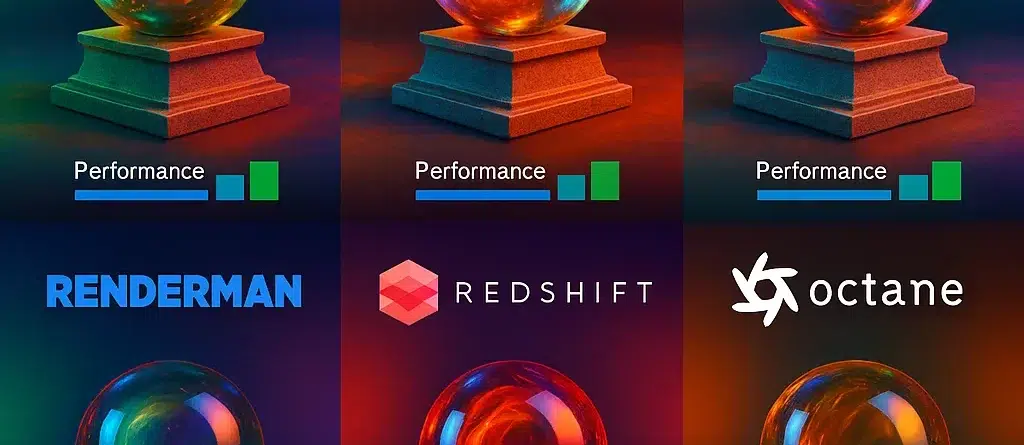
The landscape of 3D rendering has undergone substantial transformation by 2025. Advances in hardware and software have led to rendering engines that are more efficient, compatible, and capable of producing higher-quality images. This comprehensive analysis examines six prominent rendering engines: KeyShot, Arnold, V-Ray, RenderMan, Redshift, and Octane. We will explore their hardware and software compatibility, per-core performance, GPU utilization, and rendering quality to assist professionals in selecting the most suitable engine for their needs.
1. KeyShot
Hardware and Software Compatibility:
-
CPU-Based Rendering: KeyShot primarily utilizes CPU rendering, supporting both Windows and macOS platforms.
-
GPU Support: While traditionally CPU-focused, recent versions have introduced GPU acceleration, compatible with NVIDIA GPUs supporting CUDA.
Per-Core Performance:
KeyShot efficiently leverages multiple CPU cores, with rendering performance scaling linearly with the number of cores.MyArchitectAI
Rendering Quality:
Known for its real-time rendering capabilities, KeyShot offers high-quality visuals suitable for product design and marketing.
2. Arnold
Hardware and Software Compatibility:
-
CPU and GPU Rendering: Arnold supports both CPU and GPU rendering, with GPU acceleration available for NVIDIA GPUs.
-
Platform Support: Compatible with Windows, macOS, and Linux, and integrates seamlessly with applications like Maya and 3ds Max.iRender Cloud Rendering Service+1Greyscalegorilla+1
Per-Core Performance:
Arnold exhibits excellent multi-threading capabilities, efficiently utilizing available CPU cores for rendering tasks.
Rendering Quality:
Renowned for its physically accurate rendering, Arnold excels in producing high-fidelity images, particularly in film and visual effects.
3. V-Ray
Hardware and Software Compatibility:
-
Hybrid Rendering: V-Ray offers both CPU and GPU rendering options, with GPU acceleration compatible with NVIDIA CUDA and RTX technologies.
-
Platform Support: Available on Windows, macOS, and Linux, and integrates with various 3D applications including 3ds Max, Maya, and SketchUp.
Per-Core Performance:
V-Ray demonstrates strong multi-core CPU performance, with efficient scaling across multiple cores.
Rendering Quality:
V-Ray delivers photorealistic rendering, making it a popular choice in architecture, product design, and visual effects.iRender Cloud Rendering Service
4. RenderMan
Hardware and Software Compatibility:
-
CPU and GPU Rendering: RenderMan supports CPU rendering and has introduced GPU acceleration in recent versions.
-
Platform Support: Compatible with Windows, macOS, and Linux, and integrates with applications like Maya and Houdini.
Per-Core Performance:
RenderMan efficiently utilizes multiple CPU cores, offering scalable performance for complex scenes.
Rendering Quality:
Developed by Pixar, RenderMan is known for its high-quality rendering, particularly in feature film production.
5. Redshift
Hardware and Software Compatibility:
-
GPU-Based Rendering: Redshift is a GPU-accelerated renderer, compatible with NVIDIA GPUs and, in recent versions, select AMD GPUs.
-
Platform Support: Available on Windows, macOS, and Linux, and integrates with applications like Cinema 4D, Maya, and Houdini.iRender Cloud Rendering Service
Per-Core Performance:
While primarily GPU-focused, Redshift benefits from a powerful CPU for tasks like scene preparation and data management.iRender Cloud Rendering Service
Rendering Quality:
Redshift offers high-quality rendering with a balance between speed and visual fidelity, suitable for animation and visual effects.
6. Octane
Hardware and Software Compatibility:
-
GPU-Based Rendering: Octane is a GPU-exclusive renderer, requiring NVIDIA GPUs for Windows and Linux, and supporting Apple Metal for macOS.
-
Platform Support: Compatible with Windows, macOS, and Linux, and integrates with applications like Blender, Cinema 4D, and Maya.
Per-Core Performance:
Octane relies heavily on GPU performance, with minimal dependence on CPU cores.
Rendering Quality:
Octane is known for its unbiased rendering approach, producing highly realistic images with accurate lighting and materials.iRender Cloud Rendering Service
Comparative Analysis
| Rendering Engine | CPU Rendering | GPU Rendering | Per-Core Performance | Rendering Quality | Ideal Use Cases |
|---|---|---|---|---|---|
| KeyShot | Yes | Limited | Excellent | High | Product Design, Marketing |
| Arnold | Yes | Yes | Excellent | Very High | Film, VFX |
| V-Ray | Yes | Yes | Excellent | Very High | Architecture, Product Design |
| RenderMan | Yes | Yes | Excellent | Very High | Feature Films |
| Redshift | No | Yes | Good | High | Animation, VFX |
| Octane | No | Yes | Moderate | Very High | Real-Time Rendering, Visual Effects |
Conclusion
The choice of a rendering engine in 2025 depends on specific project requirements, hardware availability, and desired output quality.
-
KeyShot is ideal for designers seeking quick, high-quality renders without the need for complex setups.
-
Arnold offers exceptional rendering quality, making it suitable for high-end visual effects and animations.
-
V-Ray provides versatility and photorealistic rendering, catering to a broad range of industries.iRender Cloud Rendering Service
-
RenderMan remains a top choice for feature film production, delivering cinematic-quality renders.
-
Redshift balances speed and quality, making it a preferred option for animations and visual effects.
-
Octane excels in real-time rendering scenarios, offering unparalleled realism and speed.
Professionals should consider their specific needs, hardware configurations, and project goals when selecting a rendering engine to ensure optimal results.






Leave a Reply